Research, with receipts.
Turn an ambiguous research question into an explainable, cited literature dossier—from your terminal.
Human-approved search · transparent ranking · local evidence · passage-level citations
Try the no-key demo Watch the 2:37 video View the Build Week entry
RAGdoll is a keyboard-first workspace for planning scholarly searches, curating paper collections, acquiring approved open evidence, and producing cited research dossiers. The model proposes; the researcher approves. The application preserves the query, source, score, decision, evidence level, and exact passage behind every accepted claim.
It never scrapes Google Scholar, bypasses paywalls, or says a paper was read when only metadata or an abstract was available.
Try the real workspace
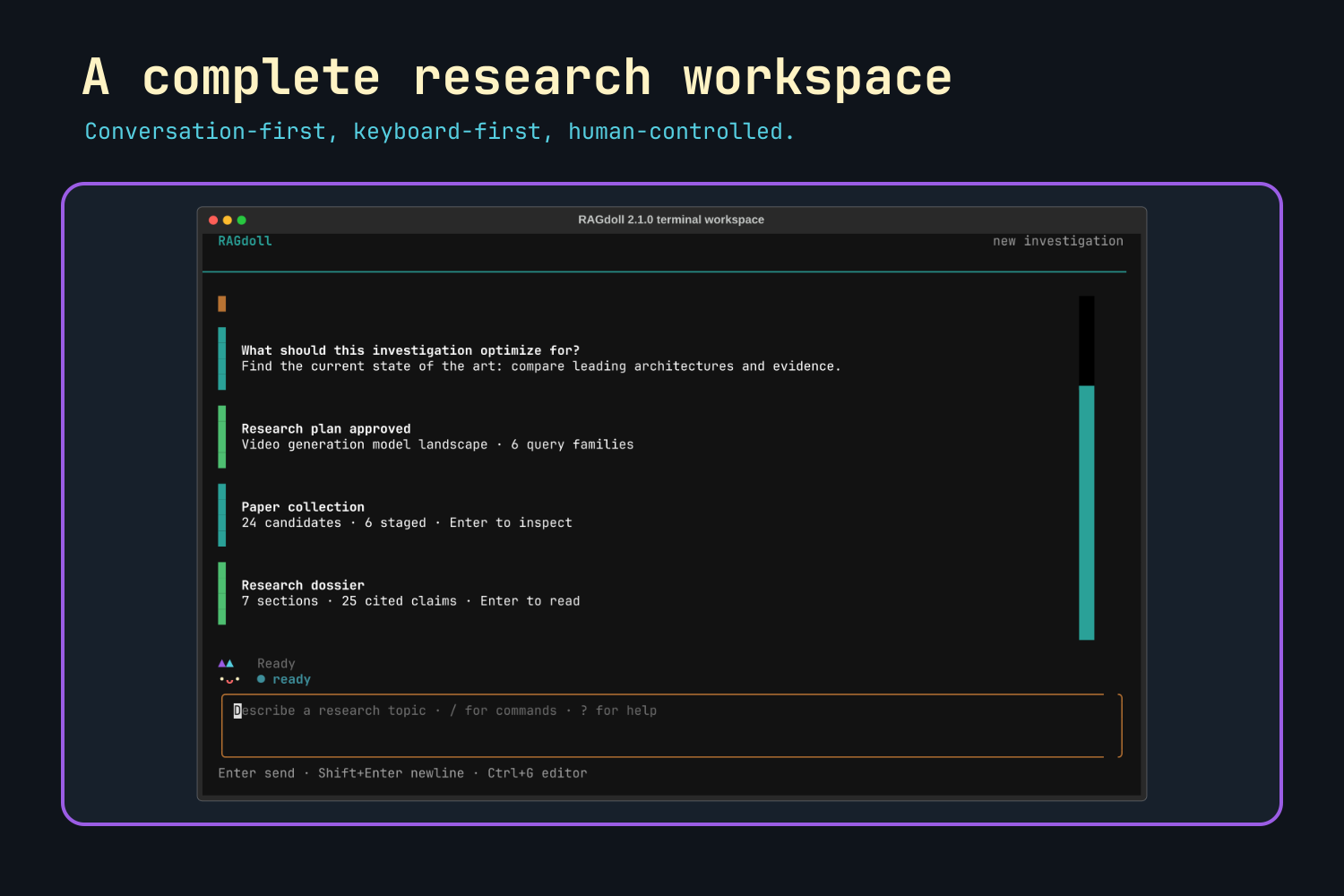
Launch a deterministic sample of the actual Textual interface from GitHub:
The demo requires Python 3.11+ and an interactive terminal, but no API key, model download, or scholarly API call after installation. It opens a temporary investigation with an approved plan, three staged papers, indexed passages, a seven-section dossier, and resolvable citations.
Where RAGdoll earns trust
Human checkpoints
Search approval, paper curation, open-full-text consent, and evidence inspection remain separate decisions. Changed inputs invalidate stale approvals and conclusions.
Visible provenance
Every discovered work retains its exact query, source identifier, retrieval time, ranking components, version group, and human staging decision.
Evidence-level honesty
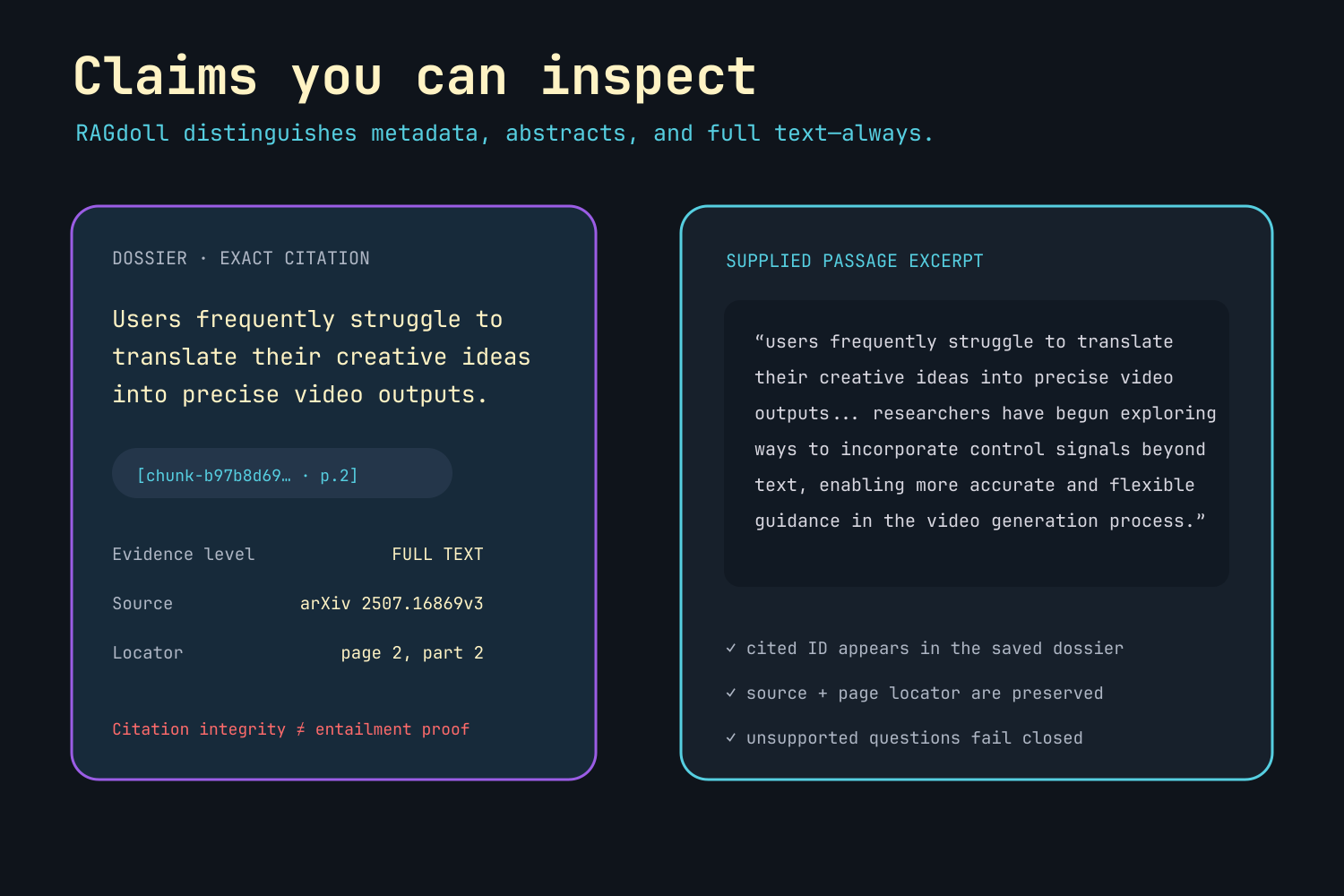
Metadata, abstract fallbacks, and open full text are labeled separately. Every accepted citation resolves to a passage supplied for that model call.
From question to cited dossier
flowchart LR
    Q[Research question] --> C[Adaptive clarification]
    C --> P[Editable plan]
    P -->|researcher approves| S[Scholarly discovery]
    S --> R[Transparent ranking]
    R -->|researcher curates| E[Local evidence index]
    E --> D[Cited dossier]
    D --> A[Grounded questions]
OpenAlex provides broad scholarly discovery, Crossref canonicalizes DOI metadata, and arXiv enriches preprint records. Reciprocal-rank fusion combines query results; DOI, arXiv, and normalized-title fingerprints group versions. Open PDFs are acquired only after a second approval and indexed locally with page-aware locators.
A recorded end-to-end run
The preserved July 15, 2026 acceptance investigation exercises the full workflow.
| Result | Recorded value |
|---|---|
| Discovery candidates | 24 |
| Human-curated papers | 6 |
| Open full-text documents | 5 |
| Labeled abstract fallbacks | 1 |
| Page-aware evidence chunks | 307 |
| Dossier sections | 7 |
| Directly supported claims in manual audit | 23 / 25 |
Every citation identifier resolved to evidence supplied for its model call. Two claims did not have direct passage support in the manual audit and remain documented: citation integrity does not by itself prove semantic entailment.
Read the acceptance record See the evaluation contract
Choose your path
Use the product
Learn the terminal experience, then follow the judge guide for the no-key demo, local Ollama workflow, or OpenAI provider.
Audit the research contract
Start with planning, continue through retrieval and ranking, then inspect the evidence and dossier contract.
Extend it safely
Read the architecture and privacy model. Provider, scholarly-source, storage, and terminal boundaries stay behind narrow adapters.
Current status
main targets RAGdoll 2.2.0, whose release remains gated on the checked-in benchmark receiving
maintainer-adjudicated relevance labels and passing every quality gate. Existing workspaces and
export formats remain compatible.